&geometry(309x90) "VSOS")
3D Orthotics: Precision External Support for Mobility
While surgery is the primary solution for many orthopaedic conditions, it isn't always the right path for every patient. Factors like advanced age, concurrent medical issues, or specific owner preferences may lead to a non-surgical approach.
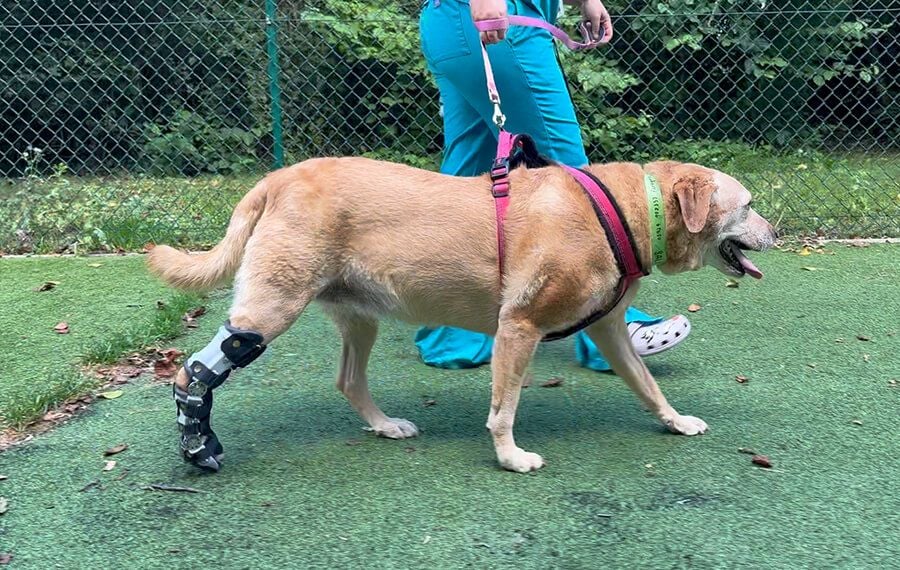
At VSOS, we utilise state-of-the-art 3D Orthotics (from industry leaders like Wimba and Scandiorthopaedic) to provide custom-engineered external support. These are not "off-the-shelf" braces; they are bespoke medical devices designed from a digital "twin" of your pet’s limb.
What are 3D-Printed Orthotics?
Traditional veterinary bracing often involved heavy, cumbersome materials that were difficult to fit accurately. Modern 3D orthotics have revolutionised this by using 3D scanning technology and advanced polymers.
Digital Precision: We use a handheld 3D scanner to create a sub-millimetre accurate digital model of your pet's leg.
Bespoke Engineering: This scan is sent to specialised labs where engineers design a brace tailored to the specific mechanical needs of the joint.
Lightweight & Breathable: 3D-printed materials are incredibly light, durable, and designed with lattice structures that allow the skin to breathe, minimising the risk of sores.
When are Orthotics Recommended?
At VSOS, we are selective about when we recommend orthotics to ensure they truly benefit the patient. We typically utilise them for:
Carpal or Tarsal Laxity/Hyperextension
For pets with "dropped" wrists (carpus) or ankles (tarsus) due to ligament weakness or injury, a custom brace provides the vertical support needed to walk with a natural gait and prevents further joint degradation.
Post-Operative Protection (e.g., Achilles Repair)
In complex soft-tissue reconstructions, such as Achilles tendon repairs, an orthotic is invaluable. It protects the surgical site during the critical first few weeks of healing, allowing for controlled, safe weight-bearing without the risk of the repair "stretching" or failing.
Digit and Paw Injuries
For chronic toe dislocations or paw deformities, specialised 3D-printed "boots" or partial limb supports can re-level the limb, improving symmetry and reducing compensatory pain.
Note on CCL Disease: At VSOS, we do not typically recommend orthotics for Cranial Cruciate Ligament (CCL) disease. Unlike the lower joints of the limb, the knee (stifle) is difficult to stabilise externally due to the surrounding muscle mass and the complex "sliding" mechanics of the joint. Surgery remains the gold standard for CCL stabilisation.
The VSOS Fitting Process
To ensure a perfect fit and successful outcome, we follow a rigorous specialist protocol:
Specialist Evaluation
We determine if your pet is a clinical candidate for an orthotic.
The Digital Scan
Using specialised scanning technology, we capture the exact geometry of the limb. No messy plaster casts are required.
The Manufacturing
The device is 3D printed using medical-grade materials tailored to your pet's weight and activity level.
Fitting & Gait Analysis
Once the device arrives, our specialists fit the brace and perform a gait analysis to ensure it is functioning correctly.
Integrated Rehabilitation
Wearing a brace requires "learning" how to move again; we guide your pet through this transition.
Why Choose Specialist-Led Orthotics?
An incorrectly fitted brace can do more harm than good, causing skin necrosis or shifting mechanical stress to other joints. At VSOS, our orthotic program is overseen by Specialist Surgeons and Certified Rehabilitation Practitioners.
We ensure the brace isn't just a "bandage" but a precise medical tool that works in harmony with your pet's anatomy.