&geometry(309x90) "VSOS")

My Dog Has Eaten Something, What Should I Do?
Dogs are curious by nature, and some are especially talented at eating things they absolutely should not.
Socks, bones, stones, toys, food wrappers, fish hooks and other household objects can all become foreign bodies if swallowed.
Sometimes you may actually see your dog eat something unusual. Other times, you may have no idea anything has been swallowed until your dog starts vomiting, stops eating or simply seems quieter than usual.
Sometimes these objects pass through without causing a problem. Other times, they can become stuck and cause a serious obstruction.
If you know or suspect your dog has swallowed something unusual, early veterinary assessment is important.
What are the signs my dog may have swallowed something?
The symptoms can vary depending on what your dog has eaten and where the object is sitting.
Common warning signs include:
Vomiting
Loss of appetite
Regurgitation
Gagging or coughing
Repeated attempts to swallow
Abdominal discomfort
Lethargy or seeming unusually quiet
Difficulty keeping food or water down
A bloated or distended abdomen
Sometimes the signs can be quite subtle at first.
A dog may seem a little off, quieter than usual or less interested in food before more obvious symptoms develop.
Where can a foreign object get stuck?
A swallowed object can potentially become lodged anywhere along the gastrointestinal tract, including the:
Oesophagus, or food pipe
Stomach
Small intestine
Large intestine or colon
Where the object is located makes a big difference to how urgently it needs to be treated and how it can be removed.
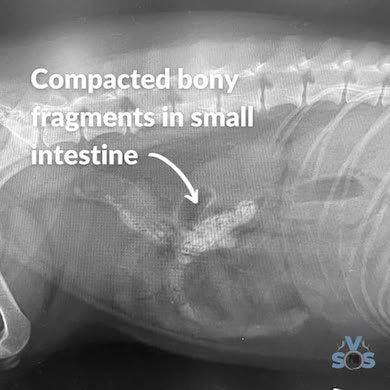
An object sitting in the stomach, for example, may sometimes be removed without surgery. An object that becomes lodged in the small intestine and causes an obstruction is much more likely to require emergency surgery.
How do vets find out what my dog has swallowed?
At VSOS, one of the first diagnostic tools we commonly use is abdominal ultrasound.
Ultrasound allows our team to assess the stomach and intestinal tract and determine whether a foreign object is present and, importantly, whether it is causing an obstruction.
X-rays can also be useful, particularly for objects such as bones, stones or fish hooks, or when excessive gas makes ultrasound more difficult.
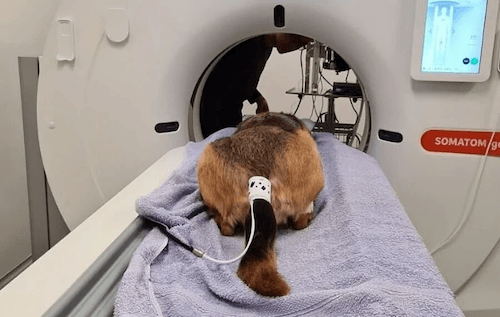
For larger dogs, or when ultrasound does not provide a clear enough answer, a CT scan may sometimes be recommended.
The goal is to identify the problem quickly so we can decide whether your dog needs monitoring, endoscopic removal or surgery.
Can a swallowed object be removed without surgery?
Sometimes, yes.
If the object is still sitting within the oesophagus, stomach or the first part of the small intestine, it may be possible to remove it using endoscopy.
Your dog is placed under anaesthetic and a flexible camera is passed through the mouth into the gastrointestinal tract. Specialised instruments can then be used to grasp the object and remove it.
This avoids opening the abdomen and can mean a much quicker recovery.
In suitable cases, a dog may be able to return home within hours.
This is one of the main reasons we encourage owners to seek veterinary attention quickly after a suspected foreign body ingestion.
The earlier the object is found, the greater the chance it may still be in a position where it can be removed without abdominal surgery.
What happens if the object reaches the intestine?
Not every foreign object requires surgery.
If an object has already travelled through the gastrointestinal tract and reached the large intestine, we may sometimes recommend supportive treatment, fluid therapy and careful monitoring while waiting for it to pass naturally.
However, an object lodged within the small intestine can cause an obstruction and becomes an emergency.
If the bowel remains obstructed, pressure from the foreign object can damage the intestinal wall. In severe cases, the affected tissue can lose its blood supply and begin to die, a process known as tissue necrosis.
The bowel can then perforate, allowing intestinal contents to leak into the abdominal cavity.
This can cause septic peritonitis, a serious and potentially life-threatening infection that requires urgent treatment
A real case: when a tiny foreign object became life-threatening
One young dog presented after experiencing vomiting and being quieter than usual.
His condition progressed, and he developed a significantly bloated abdomen.
When the VSOS team investigated, they discovered a perforated intestine and severe infection within the abdomen.
The cause was surprisingly small: a tiny metal ring that had become anchored in the bowel wall.
The perforation had allowed intestinal contents to leak into the abdominal cavity, resulting in septic peritonitis and sepsis.
He required emergency surgery followed by several days of hospital care, but thankfully made a strong recovery.
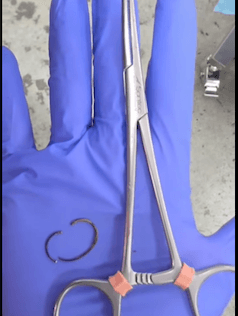
This case is an important reminder that the size of the object does not necessarily reflect the seriousness of the problem.
Even a very small foreign body can cause significant damage if it becomes lodged in the bowel. It also highlights why changes such as vomiting, reduced appetite, unusual quietness or abdominal bloating should not be ignored, even when you have not seen your dog eat anything unusual.
What if something is stuck in my dog's oesophagus?
Objects can also become lodged in the oesophagus before they ever reach the stomach.
Dogs with an oesophageal foreign body may:
Regurgitate food or water
Cough or gag
Repeatedly try to swallow
Appear distressed
Try to eat and immediately bring the food back up
Fish hooks are one example we see, particularly in coastal areas where dogs may pick up hooks that still have bait attached.
Many oesophageal foreign bodies can be removed endoscopically, especially when the dog is presented early.
If the object cannot be removed this way, surgery may occasionally be required.
Surgery involving the chest and oesophagus is considerably more complex, which is another reason early treatment is important.
Could the vomiting be caused by something else?
Yes.
Vomiting and loss of appetite can also occur with conditions such as:
Gastroenteritis
Pancreatitis
Other gastrointestinal diseases
Diarrhoea may sometimes make gastroenteritis more likely, but symptoms alone cannot always tell us the difference.
Diagnostic imaging helps determine whether there is an obstruction or another cause for your dog's illness.
When should I take my dog to the vet?
If you have seen your dog swallow an unusual object, or you suspect they may have eaten something they should not have, contact your veterinarian promptly.
You should also seek veterinary attention if your dog is:
Repeatedly vomiting
Refusing food
Regurgitating
Gagging
Struggling to swallow
Developing a bloated abdomen
Becoming increasingly quiet or lethargic
Appearing distressed
Early assessment can make a significant difference.
If the object is still in the stomach, it may be possible to remove it endoscopically before it travels further.
Waiting until it causes an intestinal obstruction, bowel damage or perforation may mean emergency surgery and intensive hospital care become necessary.
Foreign body diagnosis and treatment at VSOS
Foreign body ingestion is something the VSOS Emergency and Specialist teams manage regularly.
With access to ultrasound, X-rays, CT imaging, advanced endoscopy, surgery and intensive care in the one hospital, our team can rapidly diagnose where the foreign object is located and determine the safest way to remove it.
Where possible, we aim to use the least invasive treatment option while acting quickly enough to reduce the risk of more serious complications.
If your dog has swallowed something unusual, or is showing signs that could indicate a gastrointestinal obstruction, contact VSOS or your local veterinarian for advice as soon as possible.