&geometry(309x90) "VSOS")
Humeral Intracondylar Fissure (HIF): The Elbow Stress Fracture
Humeral Intracondylar Fissure (HIF), formerly known as Incomplete Ossification of the Humeral Condyle (IOHC), is a condition where a "fault line" or crack develops through the weight-bearing part of the elbow.
At VSOS, we view HIF as a structural stress fracture. Whether the bone failed to fuse as a puppy or developed a fatigue crack later in life, the result is a "ticking time bomb" that significantly increases the risk of a catastrophic fracture during normal activity.
What is HIF? The Stress Fracture Model
Recent research has shifted our understanding of this condition. While some dogs are born with a failure of the bone to fuse (IOHC), many others develop HIF as an acquired injury.
Fatigue Failure: Due to the unique shape of the elbow in certain breeds, the humerus (upper arm bone) experiences extreme mechanical stress.
The "Paperclip" Effect: Over time, this repetitive stress causes the bone to weaken and crack, much like bending a paperclip back and forth until it snaps.
Breeds at Risk: This is most common in English Springer Spaniels, Cocker Spaniels, French Bulldogs, and Pugs.
Symptoms:
The Hidden Warning Signs
Because HIF is a stress fracture, it often presents with subtle, "on-and-off" symptoms. This is the bone's way of warning us before a complete break occurs. Owners should watch for:
Exercise-Induced Lameness: A slight limp that appears after a walk but disappears with rest.
Reluctance to Jump: Your pet may hesitate before jumping into the car or onto the bed.
Elbow "Thickness": A slight firm swelling or discomfort when the elbow joint is handled.
Sudden Fracture: In many cases, the first sign is a complete "Y" or "T" fracture caused by a routine movement like running in the backyard.
Precision Diagnosis: Beyond Standard X-rays
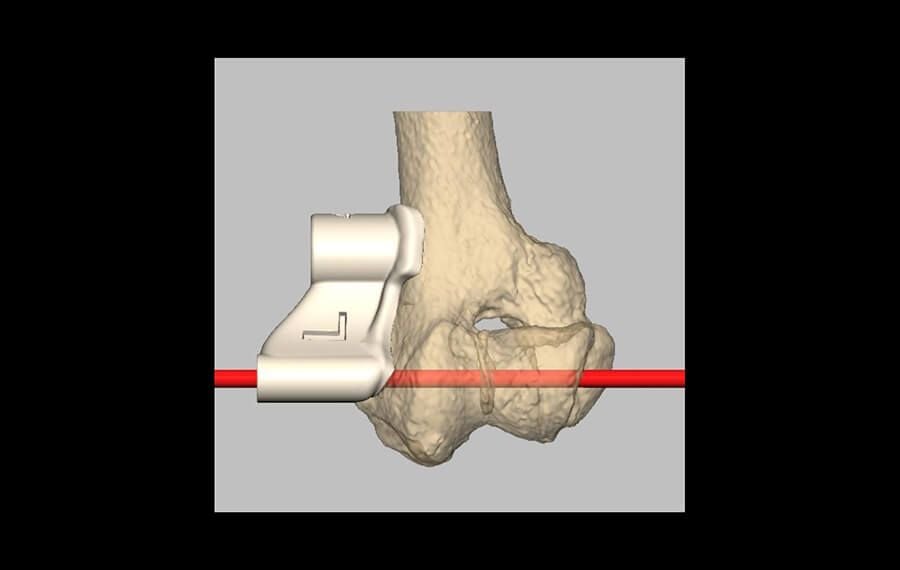
HIF is notoriously difficult to see on standard X-rays because the fissure is often paper-thin and obscured by the rest of the joint.
At VSOS, we utilise High-Resolution CT Scanning as the gold standard for diagnosis. A CT scan allows us to see the "stress line" in 3D, confirming the depth and severity of the fissure. Because the mechanical stresses are usually the same in both legs, HIF is bilateral (occurring in both elbows) in up to 50% of cases; we always scan both elbows to ensure no hidden fissures are missed.
Proactive Stabilisation: The Transcondylar Screw
If we identify an HIF stress fracture before the bone breaks, we can stabilise it with a Transcondylar Screw.
The Goal: To bridge the fissure and compress the two halves of the bone back together.
The Benefit: By placing a high-strength, medical-grade screw across the fissure, we provide internal support that stops the "paperclip" bending motion. This dramatically reduces the risk of a catastrophic fracture and eliminates the chronic pain associated with the micro-motion of the fissure.
Managing the "Y" Fracture
If the fissure progresses to a complete fracture, it results in a complex Humeral Condylar Fracture. These require emergency specialist reconstruction using multiple locking plates and screws to rebuild the elbow's "spool." While we can repair these fractures, proactive stabilisation of a fissure is always safer, less invasive, and offers a better long-term prognosis for the joint.
Prevention is better than reconstruction.
If you have a dog with a recurring limp, a proactive CT scan could prevent a major emergency.