&geometry(309x90) "VSOS")
Feline (Cat) Orthopaedic Surgery - Sydney
At VSOS, we understand that your cat is a cherished member of the family.
While cats are famously agile, they aren’t invincible. Whether it’s a fall from a height, an unexpected encounter with a vehicle, or even an awkward landing after jumping from your arms, an orthopaedic injury is a deeply stressful time for both you and your feline companion.
Our team, which includes leading-class specialists like Dr Rachel Basa, provides the calm, expert care needed to get your cat back to their curious, active self. We don't just treat the injury; we treat the whole cat, ensuring their unique feline needs are met at every stage of the journey.
The "Master of Disguise": Identifying Cat Pain
Cats are evolutionarily designed to hide physical discomfort to avoid appearing vulnerable. Unlike dogs, who may whimper or limp obviously, a cat in pain often simply “slows down.”
Cats can be silent sufferers. Rather than making their pain obvious, they may simply change how they move through daily life. A cat who no longer jumps onto the bed, hesitates before jumping down, plays less, or becomes less interactive may be showing signs of orthopaedic discomfort.
Because cats are so adept at masking injury, chronic orthopaedic issues, such as old fractures that didn’t heal correctly or ligament tears, are frequently misdiagnosed as arthritis or general “old age.”
Research suggests that a vast majority of older cats suffer from some form of orthopaedic discomfort. At VSOS, we encourage owners to look for subtle behavioural cues rather than waiting for a visible limp.
Signs your cat might be suffering from a hidden orthopaedic issue:
- Jumping Reluctance: No longer jumping onto high counters or beds, or choosing "stepping stones" (like a chair) to get to a higher surface.
- Hesitation: Pausing for a long time before jumping down from furniture.
- Behavioural Shifts: Becoming reclusive, hiding more often, or showing uncharacteristic aggression or grumpiness when touched.
- Altered Posture: Subtle changes in their gait or how they "tuck" their legs when resting.
- Reduced Appetite: Sometimes, the effort of moving to a food bowl is enough to deter a cat in pain.
It is actually quite unusual to see a cat with an obvious limp. If your cat is clearly lame or non-weight-bearing, this can indicate a serious problem and should be investigated promptly.
If your cat’s behaviour has changed, it may not just be age. A specialist evaluation can determine if a treatable orthopaedic condition is the true cause, giving your cat a new lease on life.
Helpful tip: take a video before your appointment
Cats do not always show their normal movement once they arrive at the hospital. Some will stay curled up in their carrier, while others may be too nervous to walk around the consultation room.
If you are concerned about your cat’s movement, it can be very helpful to take short videos at home before your appointment. Try to capture your cat:
- Walking across the room
- Jumping up or down from a chair, bed or couch
- Climbing stairs, if they normally use them
- Playing or moving in a way that seems different from normal
These videos can help our team better understand what you are seeing at home, especially when the signs are subtle. Think of it as bringing the “movie trailer” of the problem, because many cats prefer not to perform once they are in the consultation room.
Why Feline Orthopaedics is a Unique Discipline
At VSOS, we live by the mantra that “a cat is not a small dog.” While the basic principles of bone healing are similar across species, the feline skeletal system and biological response to trauma are unique. This requires a specialist approach that respects feline physiology.
While fractures are often obvious, some feline orthopaedic problems are much more subtle. Cats may also experience conditions such as hip dysplasia, kneecap instability, wrist or hock injuries, tendon injuries, and elbow-related pain that affects nerves and movement. These issues can be harder to detect because cats often adapt their behaviour rather than showing a clear limp.

The Paradox of Brittle vs Flexible
Cats are famously "liquid" in their movement, yet their bones are surprisingly brittle compared to dogs. This creates a specific surgical challenge: feline bones can splinter or shatter more easily under the high-velocity impact of a fall. Because of this, the way a specialist handles the bone during surgery must be incredibly delicate.

Anatomy and Forearm Rotation
One of the most significant differences between cats and dogs is the degree of forearm rotation (supination and pronation). Cats need this extreme flexibility for jumping, climbing, and grooming. Many standard orthopaedic repairs used in dogs can inadvertently restrict this rotation if applied to a cat. Our specialists, including Dr Rachel Basa, who has performed extensive research on the feline carpus (wrist), ensure that surgical repairs preserve this vital range of motion.

The Anatomy of Precision
Feline anatomy has "hidden" complexities, such as the specific opening in the humerus where major nerves and arteries pass through. Furthermore, cats have remarkably straight long bones, which require different implant alignment to ensure they regain their natural, spring-like agility.
When dealing with bones that are sometimes less than a centimetre in diameter, there is no margin for error.
Immediate Care: When Minutes Matter
If your cat has suffered a recent trauma, is suddenly unable to bear weight on a limb, or you have noticed changes in the way they walk, jump, stand or move around the home, we recommend contacting VSOS for advice or assessment. While your local vet is your primary partner in your cat’s ongoing health, trauma cases and more complex orthopaedic concerns may benefit from the immediate diagnostic support, advanced imaging and 24/7 hospital care available through a specialist emergency and referral hospital.
Triage and Stabilisation
Upon arrival, our emergency team assesses your cat for life-threatening internal injuries. This often includes:
- A-FAST and T-FAST Ultrasounds: Using ultrasound probes to quickly check for free fluid or bleeding in the abdomen or chest.
- Chest X-rays: To ensure the lungs and heart are functioning normally after a trauma.
- Stabilisation in ICU: Managing pain with injectable opioids and providing oxygen support if required.
Once stable, our in-house orthopaedic specialists, if needed, take over the surgical planning.
We believe in a collaborative approach and keep your local family vet fully informed throughout the process, ensuring they have all the records needed for your cat's long-term care.
Surgical Innovation: Beyond the Standard
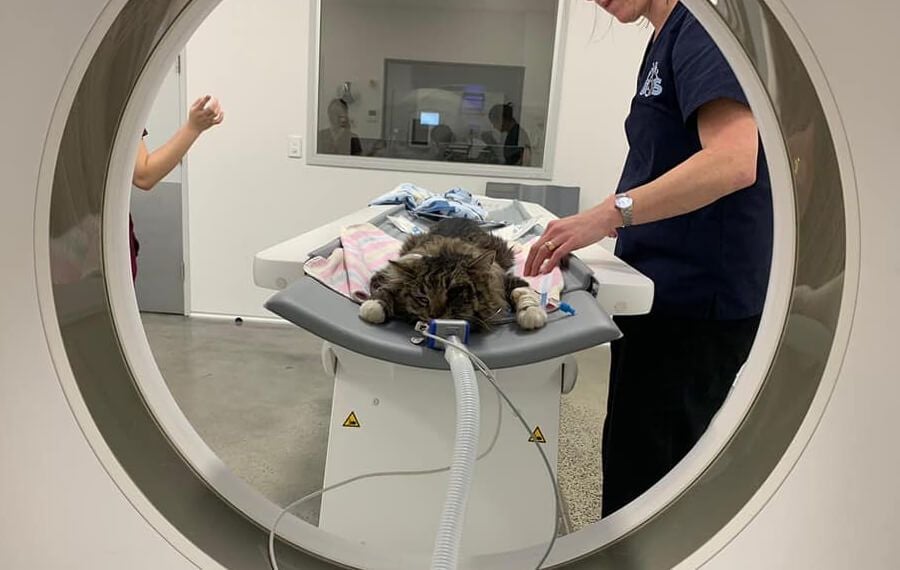
We utilise state-of-the-art technology that is rarely found in general practice. This includes intraoperative fluoroscopy, a real-time, moving X-ray, which allows us to align fractures and place implants with millimetre precision while the cat is on the operating table.
The best imaging approach depends on the problem. In many cases, we begin with X-rays to assess the bones and joints. If we need more detail, we may recommend advanced imaging such as CT, which creates a 3D view of the area, or ultrasound or MRI when soft tissues, tendons or nerves need closer assessment.
This helps us understand not only where the problem is, but also the best way to treat it.
Our expertise also extends to advanced custom solutions. Dr Rachel Basa has published research on endoprosthesis, in which 3D-printed titanium parts are used to fill bone gaps left by tumours or severe trauma. This “Beyond Possible” technology and expertise allow us to save limbs that might otherwise have required amputation.
What to Expect During a Feline Orthopaedic Assessment
Because cats often hide pain, we start by learning as much as possible about what has changed at home. We may ask about your cat’s normal routines, including where they usually jump, how they move around the house, whether they are playing less, and whether they seem less social or more withdrawn.
During the consultation, we will observe your cat’s movement where possible, then perform a careful hands-on examination. Some cats are nervous in the hospital, so our team takes a calm, patient approach. In some cases, gentle medication or treats may be used to help reduce stress and make the examination easier for your cat.
Our goal is to understand the full picture, from the obvious injury through to the subtle signs that may only be visible in your cat’s normal home environment.
The Journey to Recovery: Crate Confinement
For any orthopaedic repair to be successful, the post-operative period is critical. Most fracture repairs require six to eight weeks of strict confinement to allow the bones to heal back together without the stress of jumping or running.
In the specialist world, we refer to this as "Crate Confinement." We recommend a small, safe space (approximately 1 to 2 metres) containing:
A cut-down litter tray: So the cat doesn't have to step over a high edge with a healing limb.
Comfortable bedding: Placed away from the litter tray.
Easy access to food and water.
To give your cat the best possible start, we include an initial physical rehabilitation session with most repairs. Our dedicated rehab team works alongside our surgeons to ensure your cat regains their strength and mobility safely.
Going Beyond Possible: Possum’s Story
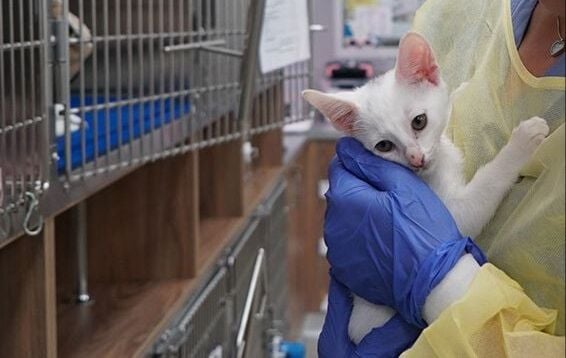
Sometimes, the most difficult cases provide the most rewarding outcomes. Meet Possum, a young cat who arrived at VSOS unable to even open her jaw. Following a trauma, she developed TMJ ankylosis, a condition where scar tissue literally "locked" her jaw joint shut.
While other hospitals said the case was too complex to repair, the VSOS multidisciplinary team utilised 3D-printed skull models and endoscopy-guided anaesthesia to perform a radical reconstruction. Today, Possum is back to her normal routine and eating solid food with ease.
Meet Dr Rachel Basa
Specialist Surgeon & Associate Professor
Dr Rachel Basa is a leading authority in feline orthopaedics. She has dedicated her career to understanding the nuances of how cats move and heal, having completed a PhD focused specifically on the feline carpus, or wrist.
Rachel’s interest in feline orthopaedics is also personal. Her own cat, Prince, came into her life as a young cat with a tibial fracture and has since lived with several orthopaedic issues. This has helped shape her understanding of how quietly cats can live with pain, and how important it is to recognise subtle changes early.
Rachel is an active researcher and academic, regularly publishing new findings and lecturing at national veterinary conferences. Her goal is to close the gap in feline orthopaedic knowledge, ensuring that cats receive care that is specifically designed for their biology, not just extrapolated from dogs.
When you meet Rachel, you are meeting a specialist who is as passionate about your cat’s recovery as you are.