&geometry(309x90) "VSOS")
Arthrodesis (Restoring Function through Joint Fusion)
While our primary goal in veterinary orthopaedics is usually to maintain joint mobility, there are circumstances where a joint is too damaged, painful, or unstable to function. In these cases, arthrodesis, the surgical fusion of a joint, can be a life-changing procedure that eliminates chronic pain and restores a high quality of life for your pet. While the idea of "fusing" a joint sounds restrictive, for many pets, it is the key to returning to a life of running and playing.
What is Arthrodesis?
Arthrodesis is a surgical procedure that intentionally fuses the bones of a joint together so they no longer move independently. By turning a painful, unstable joint into a single, solid bone, we remove the source of the pain (nerve endings in the joint capsule and bone-on-bone friction) and provide a stable platform for walking.
It is typically recommended in two main scenarios:
Irreparable Injury: When a joint is so severely damaged that a standard repair cannot provide enough stability to support the pet’s weight.
Chronic Pain: When a joint develops end-stage arthritis which causes constant suffering, fusion eliminates the painful friction of bone-on-bone movement.
The Impact on Mobility
A common concern for owners is how a fused joint will affect their pet's ability to walk. The effect on mobility varies significantly from joint to joint. Some fusions have a very minimal impact on overall movement, while others may result in a more mechanical gait—but in almost all cases, the pet is more mobile than they were when they were in pain.
Common Arthrodesis Procedures
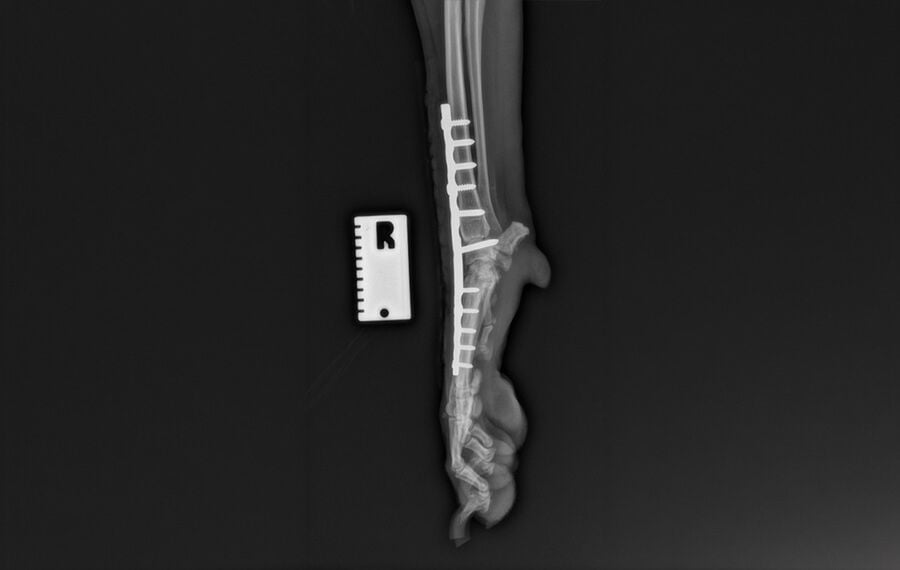
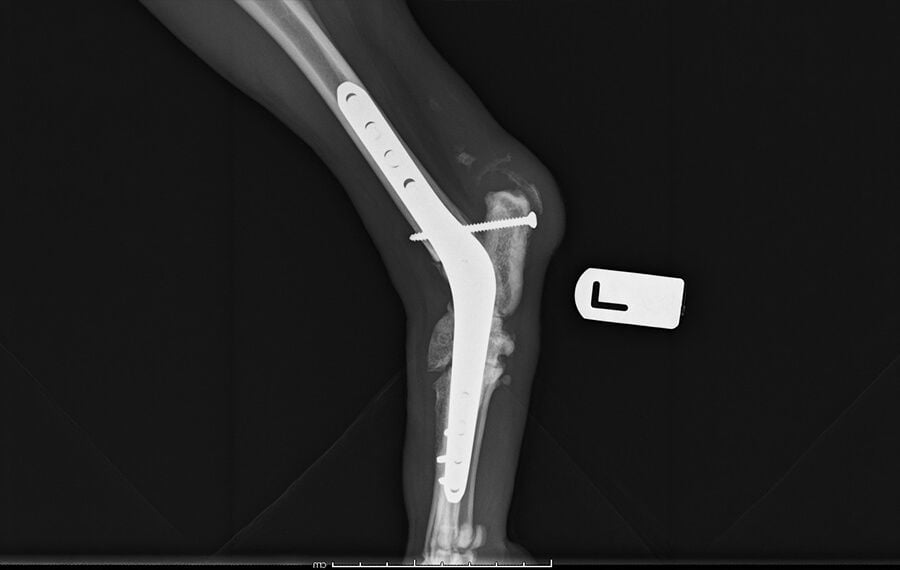
Pancarpal Arthrodesis (fusion of the wrist)
This is the complete fusion of the carpus (the joint between the paw and the elbow). Despite the joint being fused solid, overall limb function usually remains excellent. This is because the shoulder and elbow joints compensate for the lack of movement at the wrist.
- Appearance: To the untrained eye, a dog or cat with a fused carpus will often walk and run normally.
- Common Indications: Most frequently performed for hyperextension injuries (common in active dogs who land awkwardly) and complex fractures of the carpal bones.
Pantarsal Arthrodesis (full fusion of the ankle)
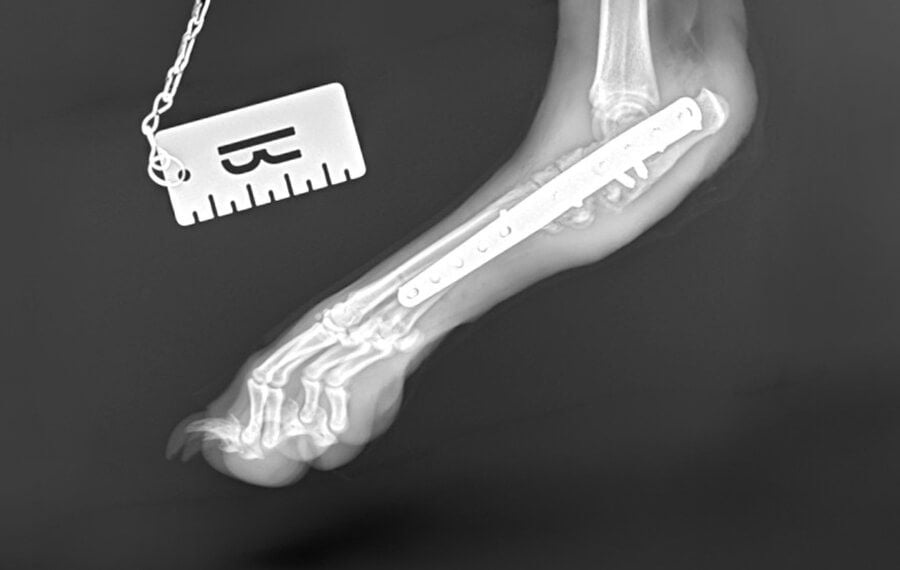
This is the complete fusion of the tarsus, or hock (the joint between the paw and the knee).
- Appearance: This procedure has a more obvious effect on a pet's gait compared to the front limb. Because the hock is vital for "spring," the pet may have a slightly stiffer step. However, dogs and cats still regain very good mobility and are typically able to run and play happily after surgery.
- Common Indications: Performed for pets with severe hock arthritis or catastrophic injuries, such as Achilles tendon ruptures or severe ligament instability.
Intertarsal Arthrodesis (partial fusion of the ankle)
This is the complete fusion of the tarsus, or hock (the joint between the paw and the knee).
- Appearance: This procedure has a more obvious effect on a pet's gait compared to the front limb. Because the hock is vital for "spring," the pet may have a slightly stiffer step. However, dogs and cats still regain very good mobility and are typically able to run and play happily after surgery.
- Common Indications: Performed for pets with severe hock arthritis or catastrophic injuries, such as Achilles tendon ruptures or severe ligament instability.
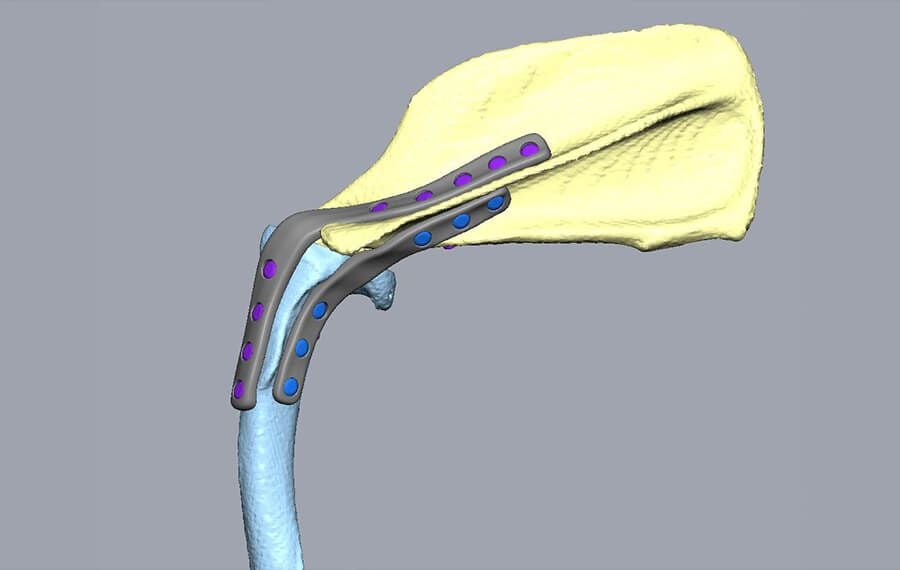
Shoulder Arthrodesis (fusion of the shoulder)
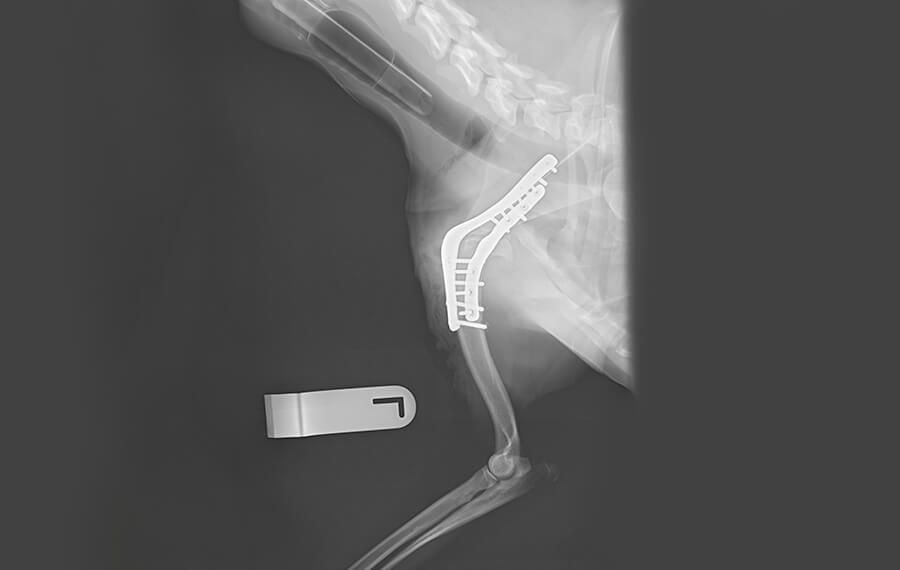
Fusion of the scapulohumeral joint (where the shoulder blade meets the upper arm bone).
- Function: This procedure has a more pronounced effect on gait than lower-limb fusions. Because the shoulder is now fixed, the pet moves the limb using the muscles that rotate the shoulder blade (scapula) against the chest wall. While the gait has a "mechanical" swing to it, it allows for comfortable, weight-bearing movement.
- Indications: Typically reserved for chronic, non-reducible shoulder dislocations (luxations), severe instability, glenoid dysplasia or end-stage osteoarthritis.
Stifle Arthrodesis (fusion of the knee)
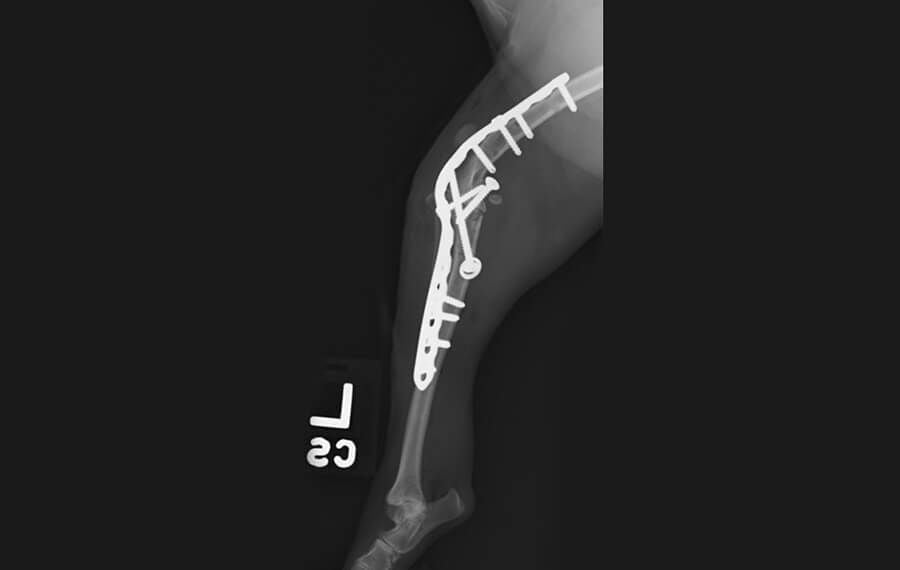
Fusion of the stifle (the joint between the femur and the tibia).
- Function: This is a major salvage procedure. Because the knee cannot bend, the leg remains at a fixed angle. Pets adapt by swinging the leg slightly outward when walking. While the gait is significantly altered, it is a successful alternative to amputation for a painful, non-functional limb.
- Indications: Performed in "end-of-the-road" cases, such as catastrophic trauma, severe chronic infection, or failed ligament reconstructions where the joint cannot be saved.
Advanced Techniques for Quicker Healing
At Veterinary Specialists of Sydney, we utilise a multi-modal approach to "bio-enhance" the fusion process. By combining mechanical stability with biological catalysts, we aim for the fastest possible recovery.
Autogenous Bone Grafting (The Gold Standard)
Successful fusion requires a "living bridge" of bone to grow across the joint. To achieve this, we perform bone graft harvesting during the surgery.
- The Process: We typically harvest a small amount of cancellous (spongy) bone from the patient's own proximal humerus (shoulder) or ilial wing (pelvis).
- The Benefit: Because this graft comes from the patient’s own body, it contains live bone-forming cells and minerals that provide the perfect scaffold for new bone growth.
Bone Morphogenetic Protein (BMP)
To further accelerate the healing process, we often utilise Bone Morphogenetic Protein (BMP).
- Biological Booster: BMP is a powerful growth factor that "signals" the body’s stem cells to transform into new bone-producing cells.
- Synergy: When combined with the bone graft, BMP acts like a biological turbocharger, significantly increasing the speed and reliability of the fusion.
Rigid Fixation & Reduced Casting Time
Traditional arthrodesis often required months of heavy, cumbersome casting. At VSS, we use high-strength Specialist Locking Plates that provide extreme mechanical rigidity.
- Earlier Mobility: Because the internal fixation is so stable and the BMP-enhanced healing is so rapid, we can often significantly reduce the time your pet spends in a cast or bandage.
- Superior Comfort: Reducing casting time minimises the risk of "bandage sores," muscle atrophy, and joint stiffness in the rest of the limb, allowing for an earlier and more comfortable transition to physical rehabilitation.
What to Expect During Recovery
Even with advanced technology, the bone still needs time to reach full strength.
The First 8-12 Weeks: Activity is strictly controlled to ensure the fusion "sets" properly.
Monitoring: We use digital X-rays to track the progress of the bone bridge.
The Result: Once fusion is confirmed, your pet can return to a life of pain-free movement, without the need for long-term anti-inflammatory medications.
Why Choose VSOS?
Arthrodesis is a precision-based surgery. Our specialists use advanced techniques to ensure the limb is fused at the optimal functional angle for your pet's specific anatomy. By combining surgical expertise with biological boosters like BMP, we aim to get your pet back on their feet faster and with fewer complications.
Is your pet struggling with chronic joint pain?
A consultation with our orthopaedic team can help determine if arthrodesis is the right path forward for your family.